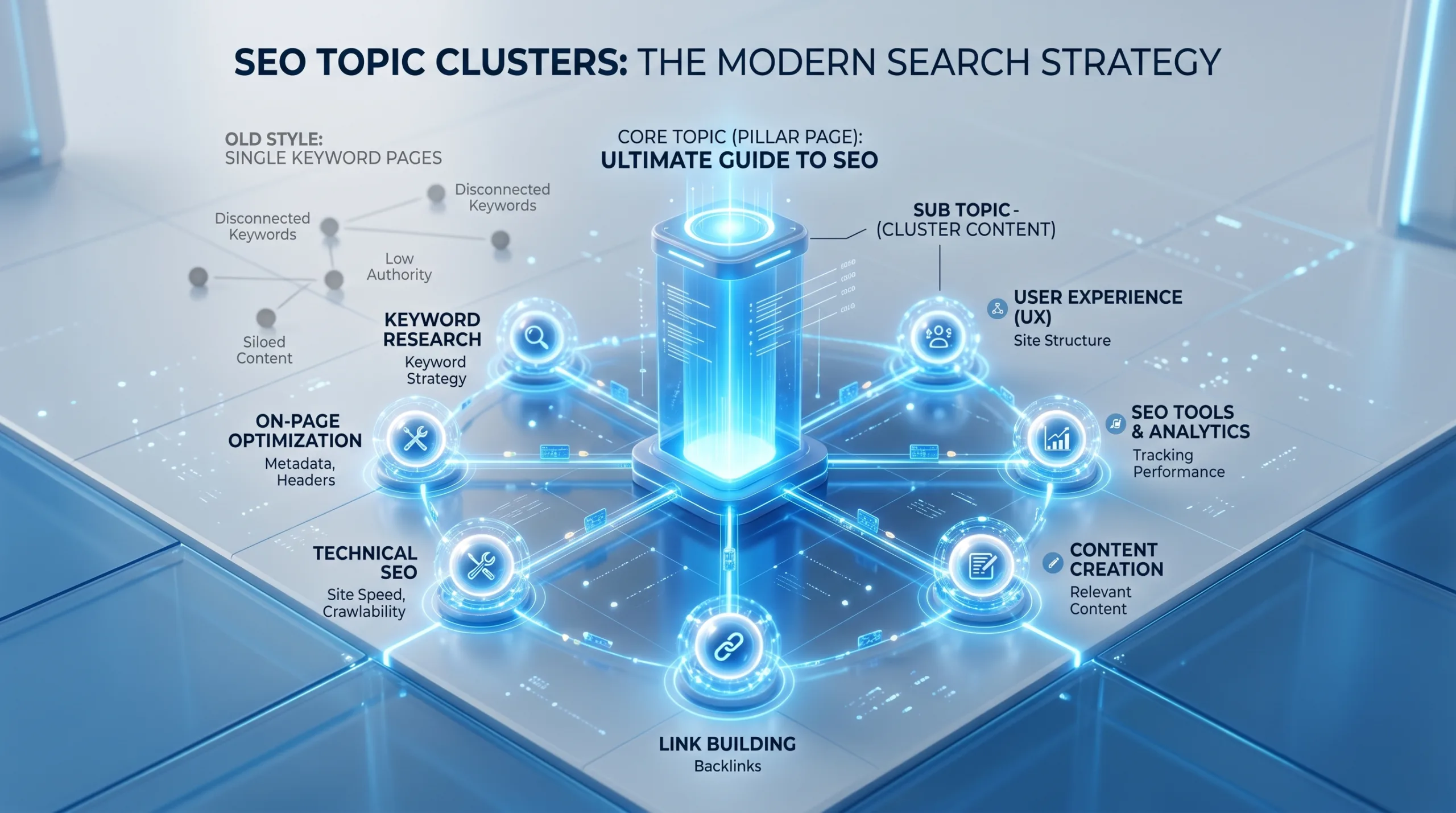
For years, topic SEO professionals built entire content strategies around individual keywords. A website might create one page targeting “best running shoes,” another targeting “top running shoes,” and another targeting “running shoes review.”
While this approach worked in the past, modern search engines have become significantly smarter. Today, Google understands that these phrases often represent the same underlying topic. Instead of rewarding dozens of nearly identical pages, search engines increasingly reward comprehensive resources that fully explain a subject.
This is where topic clusters become powerful. A topic cluster consists of a central pillar page supported by multiple related articles.
The pillar page covers the broad topic, while supporting articles explore specific subtopics in depth. Together, these pages create a connected knowledge hub that helps search engines understand your expertise.
Table of Contents
Think of a topic cluster like a university department. A single professor may know one subject well, but an entire department demonstrates authority across a complete field of study. Search engines evaluate websites in a similar way. A website with one article about SEO looks informative. A website with dozens of interconnected articles covering technical SEO, link building, entity SEO, local SEO, content marketing, structured data, and AI search appears authoritative.
Research across the SEO industry shows that topical authority is becoming one of the strongest ranking signals in modern search. AI-powered search systems prefer websites that demonstrate broad expertise because these sources are more reliable when generating answers. Rather than asking whether a page contains a keyword, search engines increasingly ask whether the website genuinely understands the topic. This shift changes everything about content strategy. Instead of producing isolated articles, successful brands build interconnected knowledge ecosystems.
The Difference Between Keyword SEO and Entity SEO
The contrast between traditional SEO and entity SEO can be dramatic. Understanding these differences helps explain why so many old SEO tactics are losing effectiveness.
| Traditional Keyword SEO | Modern Entity SEO |
|---|---|
| Focuses on words | Focuses on meaning |
| Optimizes individual pages | Optimizes topic ecosystems |
| Measures keyword density | Measures topic coverage |
| Targets exact phrases | Targets entities and relationships |
| Relies heavily on rankings | Focuses on authority and trust |
| Creates isolated content | Creates interconnected content clusters |
| Searches for keyword opportunities | Builds topical expertise |
This does not mean keywords are dead. Keywords still provide valuable insight into user intent. They help identify what people are searching for and how they phrase questions. The difference is that keywords are now inputs rather than the final goal. They help reveal topics, entities, and relationships that need to be covered.
Many SEO experts describe this shift as moving from “strings to things.” A string is simply a collection of words. A thing is an identifiable entity with meaning and context. Google’s algorithms increasingly prioritize understanding things rather than matching strings. This transformation explains why pages can rank for thousands of keywords they never explicitly target. Search engines understand the topic well enough to connect relevant searches automatically.
How Google’s Knowledge Graph Changed SEO Forever
One of the most important developments in search history was the introduction of the Knowledge Graph. This system allows Google to understand entities and the relationships between them rather than simply indexing pages full of text. The Knowledge Graph connects people, companies, products, locations, events, and concepts into a massive network of information.
Today, industry estimates suggest Google’s Knowledge Graph contains billions of entities and hundreds of billions of facts. This enormous database helps Google answer questions, generate AI Overviews, display Knowledge Panels, and understand content relevance at a much deeper level than traditional keyword matching ever could.
Imagine someone searches for “Apple founder.” Google does not simply look for pages containing the words “Apple” and “founder.” Instead, it recognizes Apple as a company entity and understands its relationship with specific individuals. That entity relationship allows Google to provide highly accurate answers instantly.
The same principle applies to every niche. Whether your website covers finance, healthcare, technology, insurance, education, or marketing, search engines are mapping entities and their relationships. The more clearly your content fits within these entity networks, the easier it becomes for Google and AI systems to understand your expertise.
This is why modern SEO requires a broader perspective. Success no longer comes from optimizing pages for isolated keywords. Success comes from becoming a recognized authority within a network of related entities and topics. Websites that embrace this reality are positioning themselves for long-term visibility, while websites relying on outdated keyword tactics are finding it increasingly difficult to compete.

1 thought on “Why Topic Clusters Are Replacing Single Keyword Pages”