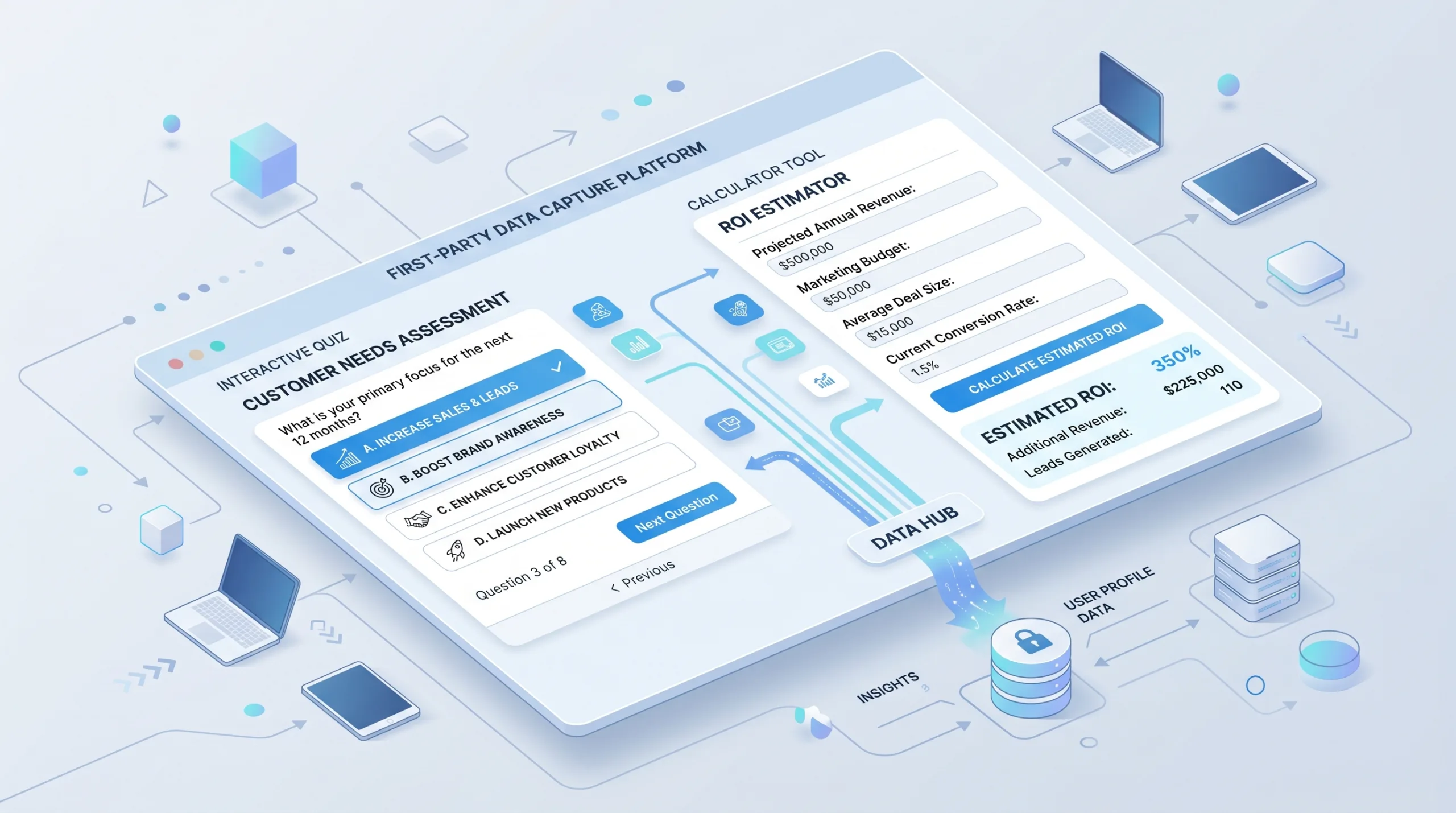
Before diving into the article, it’s important to understand why this topic has become so critical. The marketing world has entered a new era where first-party and zero-party data are replacing third-party tracking as the foundation of customer intelligence. The decline of third-party cookies and growing privacy expectations have forced brands to rethink how they collect and use customer information.
Interactive experiences such as quizzes and calculators have emerged as some of the most effective solutions because they create value for users while generating highly accurate data for businesses. Recent industry research shows that interactive content generates significantly higher engagement and conversion rates than passive content, making it a powerful asset for modern marketers.
Table of Contents
The Growing Importance of First-Party Data
The digital marketing landscape has undergone a dramatic transformation over the last few years. Brands that once depended heavily on third-party cookies now find themselves operating in an environment where privacy regulations, browser restrictions, and changing consumer expectations have fundamentally altered the rules of engagement.
As tracking technologies disappear, marketers are searching for sustainable ways to understand their audiences without relying on external data providers. This shift has elevated first-party data from a useful asset to a strategic necessity.
First-party data refers to information collected directly from users through owned channels such as websites, apps, email subscriptions, purchases, and interactive experiences. Unlike third-party data, which often relies on inferred behaviors, first-party data reflects actual interactions and expressed interests. This makes it significantly more accurate and valuable for personalization efforts. Industry research indicates that businesses using first-party data alongside other marketing signals often achieve stronger conversion performance because the information is more relevant and trustworthy.
What makes this transition particularly important is that businesses now need to create experiences that encourage users to willingly share information. Instead of passively tracking behavior behind the scenes, companies must actively earn customer trust. Interactive content serves as the bridge between these goals. By offering users something valuable, entertaining, or insightful, brands can collect meaningful information while simultaneously enhancing customer experience. It is a win-win model that aligns perfectly with the privacy-first future of digital marketing.
Why Third-Party Data Is Losing Relevance
The decline of third-party cookies is more than a technical change; it represents a philosophical shift toward consumer control. Modern internet users increasingly expect transparency regarding how their information is collected and used. Browser restrictions and privacy regulations have accelerated this movement, making traditional tracking methods less effective and less reliable.
Why Users Prefer Interactive Experiences
Interactive content stands out because it transforms audiences from passive observers into active participants. Rather than scrolling through information, users engage directly with content, answer questions, enter data, and receive personalized results. This level of involvement creates a stronger emotional connection and improves memory retention. Studies show that interactive content can generate significantly higher engagement than static content while increasing time spent on page and conversion rates.
Understanding Interactive Content
Interactive content includes any digital experience that requires user participation. Examples include quizzes, calculators, surveys, assessments, configurators, polls, and recommendation engines. The common factor among all these formats is that users contribute information in exchange for a customized experience.
Think about the difference between reading a generic article about financial planning and using a retirement calculator that estimates your future savings based on your specific circumstances. The calculator instantly feels more relevant because it revolves around you. That personalized experience creates value while simultaneously generating valuable data for the business offering the tool.
Research suggests that interactive content often delivers double the conversion performance of passive content because users become emotionally invested in the experience. Rather than simply consuming information, they are creating a personalized outcome. This engagement dramatically increases the likelihood that they will complete the interaction and share contact information.
What Makes Content Interactive?
Interactive content invites participation through actions such as selecting answers, entering figures, comparing scenarios, or receiving tailored recommendations. These activities transform a standard webpage into a dynamic conversation.
Why Users Prefer Interactive Experiences
People naturally enjoy discovering information about themselves. Whether it is a personality quiz, a marketing assessment, or a cost calculator, the promise of personalized insight triggers curiosity and encourages participation. This psychological mechanism helps explain why quizzes consistently achieve strong completion rates.
Why Quizzes Are Powerful Data Collection Tools
Among all interactive formats, quizzes are perhaps the most versatile and widely adopted. They combine entertainment, personalization, and data collection into a single experience. For marketers, quizzes offer a unique opportunity to learn about customer preferences, challenges, goals, budgets, and purchasing intentions without making the process feel intrusive.
Research indicates that quizzes often achieve completion rates ranging from 65% to 85%, while lead conversion rates frequently exceed 40% among participants. These numbers far surpass the performance of many traditional lead generation methods.
The Psychology Behind Quiz Engagement
The effectiveness of quizzes can largely be explained through psychology. Humans are naturally curious about themselves. Questions such as “What type of investor are you?” or “Which software solution fits your business?” create a knowledge gap that motivates users to continue until they discover the answer. The anticipation of personalized results keeps engagement high throughout the experience.
Types of Marketing Quizzes
| Quiz Type | Purpose | Data Collected |
|---|---|---|
| Personality Quiz | Audience segmentation | Interests, preferences |
| Product Finder Quiz | Product recommendations | Buying intent, needs |
| Assessment Quiz | Problem diagnosis | Pain points, goals |
| Knowledge Quiz | Education and engagement | Expertise level |
| Readiness Quiz | Lead qualification | Budget, timeline |
These formats allow businesses to gather meaningful insights while providing users with immediate value.
How Calculators Drive High-Intent Leads
While quizzes excel at audience segmentation, calculators often attract users who are closer to making a purchasing decision. Someone using an ROI calculator, pricing estimator, or savings calculator typically has a specific goal in mind. This makes calculators particularly effective for generating high-quality leads.
Calculators create an environment where users willingly provide detailed information because doing so improves the accuracy of the result. The more data they enter, the more useful the outcome becomes. This creates a natural and transparent data collection process that feels beneficial rather than invasive.
Industry reports suggest that calculators can generate significantly higher engagement and conversion rates compared to traditional forms. Pricing calculators and ROI tools are especially effective because they help users justify decisions and reduce uncertainty.
Financial and ROI Calculators
ROI calculators help prospects estimate the value of a product or service before committing to a purchase. By demonstrating tangible outcomes, these tools increase confidence and shorten decision-making cycles.
Pricing and Cost Estimation Tools
Cost calculators are highly effective because they address one of the most common customer questions: “How much will this cost me?” Instead of forcing users to contact sales representatives, calculators provide immediate answers while collecting valuable qualification data.
The Relationship Between Value Exchange and Data Collection
The success of interactive content hinges on a simple principle: value exchange. Users are far more willing to share information when they receive something useful in return. A quiz result, personalized recommendation, financial estimate, or performance benchmark can all serve as incentives for participation.
This approach differs significantly from traditional lead forms. Instead of asking for information upfront, interactive experiences provide value first and request contact details later. By the time users reach the opt-in stage, they have already invested time and effort into the experience. This increases perceived value and improves conversion rates. Research shows that interactive experiences often outperform static forms by substantial margins.
Building Trust Through Transparency
Transparency is essential. Users should understand what data is being collected and how it will be used. Clear communication strengthens trust and increases willingness to participate.
Collecting Zero-Party and First-Party Data
Interactive experiences often collect both first-party data and zero-party data. Zero-party data refers to information users intentionally provide, such as preferences, goals, or interests. This type of data is particularly valuable because it comes directly from the customer.
Designing High-Converting Quizzes
Creating an effective quiz requires more than assembling a list of questions. The best quizzes balance engagement, relevance, and data collection. Every question should serve a purpose while contributing to a smooth user experience.
Successful quizzes typically keep questions concise, use conversational language, and maintain momentum. Visual elements can further improve engagement by making the experience more enjoyable. Research suggests that personalized results significantly increase completion rates and user satisfaction.
Question Strategy
Each question should reveal meaningful information about the participant while moving them closer to a personalized outcome. Avoid unnecessary complexity and focus on actionable insights.
Result Personalization
The result page is where the magic happens. Tailored recommendations, insights, and next steps transform the quiz from a simple data collection tool into a valuable customer experience.
Building Effective Interactive Calculators
Calculators succeed when they solve real problems. The most effective tools address important questions that customers are already asking. Whether estimating savings, calculating ROI, or projecting outcomes, calculators should provide immediate and actionable value.
The user experience must remain intuitive. Complex calculations can happen behind the scenes, but the interface should feel simple and approachable. Users should never feel overwhelmed by technical details.
User Experience Best Practices
Keep input fields relevant, minimize friction, and display results clearly. The easier the process feels, the more likely users are to complete it.
Data Capture Opportunities
Every field entered into a calculator represents a potential insight. Businesses can use this information to segment leads, personalize communications, and improve marketing effectiveness.
Measuring Success
Interactive content should be evaluated using clear performance metrics. While engagement is important, the ultimate goal is often lead generation, customer acquisition, or revenue growth.
Essential KPIs
Key performance indicators include:
| Metric | Why It Matters |
|---|---|
| Completion Rate | Measures engagement |
| Lead Capture Rate | Evaluates conversion success |
| Time on Page | Indicates interest level |
| Cost per Lead | Measures efficiency |
| Revenue Attribution | Connects activity to business results |
Interactive content consistently performs well across these metrics. Studies show higher engagement, stronger lead generation, and improved conversion outcomes compared with static alternatives.
Attribution and Revenue Impact
Businesses should connect interactive experiences to downstream outcomes such as sales opportunities, purchases, and customer lifetime value. This provides a complete picture of ROI.
Future Trends in Interactive Data Collection
The future of marketing belongs to brands that create meaningful exchanges with customers. Interactive experiences will become increasingly sophisticated, incorporating artificial intelligence, predictive analytics, and hyper-personalized recommendations. Instead of generic interactions, users will receive experiences tailored to their unique needs and preferences.
AI-powered quizzes and calculators will further improve data quality while reducing friction. Businesses will gain deeper insights, and customers will enjoy more relevant experiences. As privacy regulations continue to evolve, interactive content will remain one of the most effective methods for collecting consent-based data.
The organizations that embrace this shift early will gain a significant competitive advantage. They will build richer customer profiles, deliver more personalized experiences, and establish stronger trust with their audiences.
Conclusion
Quizzes and calculators have evolved far beyond simple engagement tools. They are now strategic assets that help businesses capture high-quality first-party and zero-party data while delivering meaningful value to users. In a world where privacy expectations are rising and third-party tracking is disappearing, interactive content offers a sustainable path forward.
The beauty of this approach lies in its mutual benefit. Customers receive personalized insights, recommendations, and answers to important questions. Businesses gain accurate, permission-based data that improves targeting, personalization, and conversion performance. When executed effectively, quizzes and calculators transform data collection from a transactional process into a genuinely helpful experience.
Brands that invest in interactive content today are not merely adapting to a changing digital landscape. They are positioning themselves for long-term success in a future where trust, relevance, and customer participation drive marketing performance.
FAQs
1. What is first-party data?
First-party data is information collected directly from users through channels you own, such as websites, apps, email subscriptions, and interactive content experiences.
2. How do quizzes help collect customer data?
Quizzes gather information through user responses while providing personalized results, making the data collection process feel valuable and engaging.
3. Why are calculators effective for lead generation?
Calculators attract users with specific needs and high purchase intent, often resulting in higher-quality leads and stronger conversion rates.
4. What is the difference between first-party and zero-party data?
First-party data comes from observed user interactions, while zero-party data is information that users intentionally and proactively share with a brand.
5. Which industries benefit most from interactive content?
E-commerce, SaaS, financial services, healthcare, education, real estate, and professional services all benefit significantly from quizzes, calculators, and other interactive tools.
Thank you 24

1 thought on “The Interactive Advantage: Using Quizzes and Calculators to Capture First-Party Data”