
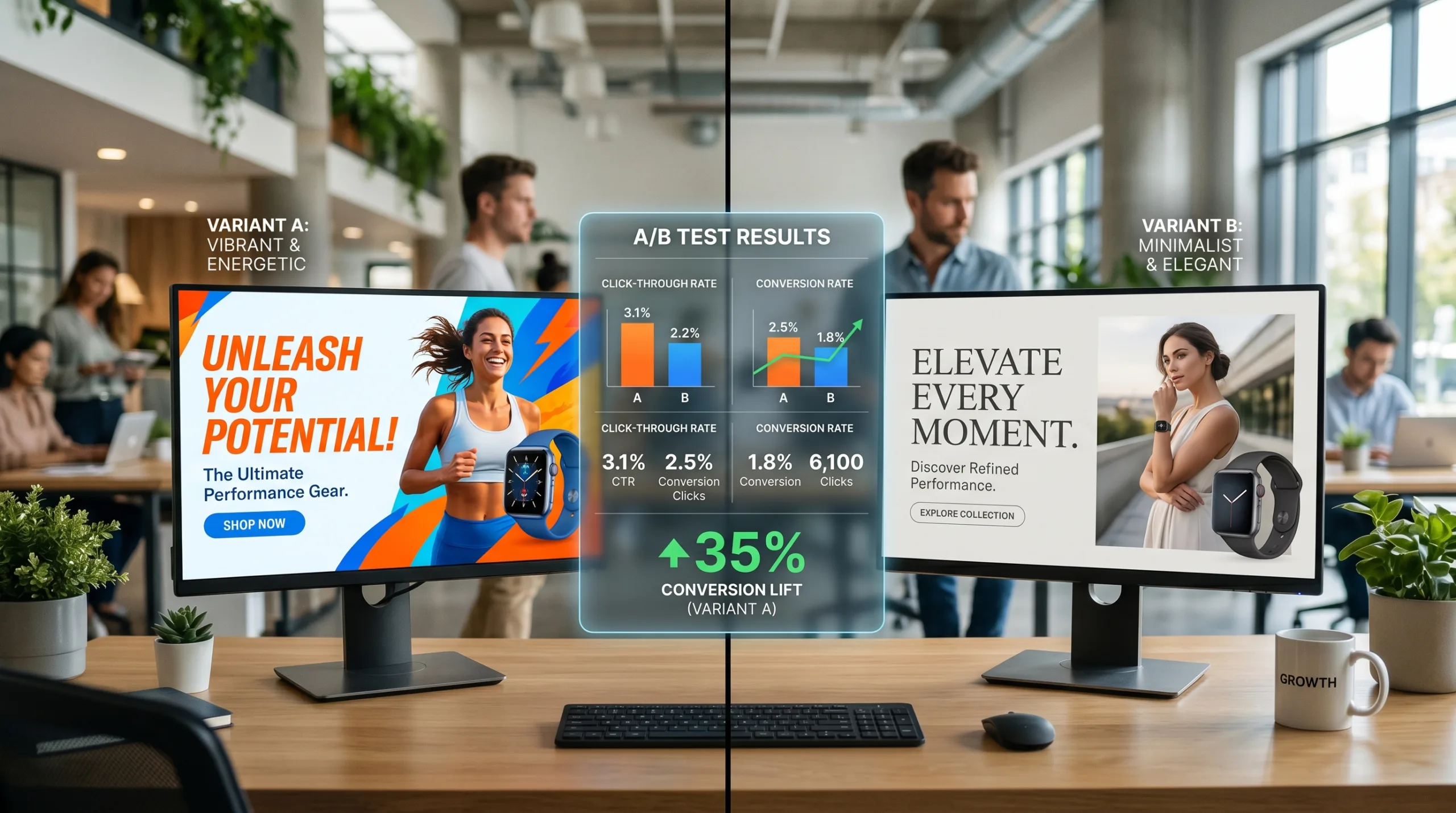
Before spending more money on ad creative, marketers need to answer one simple question: Are your creatives actually working, or are you just guessing?
Recent advertising studies show that creative quality is now one of the biggest factors influencing campaign performance. Meta reports that creative can account for around 56% of ad performance variation, making it more important than audience targeting in many cases. Testing creatives systematically has become essential for brands that want higher click-through rates, lower acquisition costs, and stronger return on ad spend.
Article Outline
- H1: Testing Like a Pro: How to Run Meaningful Split Tests on Your Ad Creatives
- H2: Why Ad Creative Testing Matters More Than Ever
- H2: Understanding Split Testing in Advertising
- H3: What Is a Split Test?
- H3: Split Testing vs Guesswork
- H2: Setting Clear Testing Goals
- H3: Choosing the Right KPI
- H2: Building a Strong Testing Framework
- H3: Creating a Hypothesis
- H3: Defining Success Metrics
- H2: Variables You Should Test
- H3: Headlines
- H3: Images and Videos
- H3: Hooks
- H3: Call-to-Action Elements
- H2: The One-Variable Rule
- H2: How Much Budget You Need
- H2: Statistical Significance Explained
- H3: Why Small Samples Mislead
- H2: Common Creative Testing Mistakes
- H3: Ending Tests Too Early
- H3: Testing Too Many Changes
- H2: Creative Fatigue and Refresh Cycles
- H2: AI and Modern Creative Testing
- H2: Creating a Repeatable Testing Process
- H2: Conclusion
- H2: FAQs
Why Ad Creative Testing Matters More Than Ever
The advertising world has changed dramatically over the past few years. Privacy updates, increased competition, and rising advertising costs have made targeting less powerful than it once was. As a result, the creative itself has become the primary driver of campaign success. Think about it like a fishing trip. The audience is the lake, but the creative is the bait. If the bait is weak, even the best lake will not help you catch many fish.
Modern advertising platforms such as Meta, TikTok, YouTube, and Google are becoming increasingly automated. These systems can find audiences efficiently, but they still depend on compelling creative assets. Research across advertising platforms consistently shows that strong creatives outperform average ones by significant margins, even when targeting and budgets remain identical.
Many advertisers still rely on instinct when creating ads. They launch a campaign, wait a few days, and decide whether an ad is good based on feelings rather than data. This approach wastes money and slows growth. Proper split testing replaces assumptions with evidence. Instead of asking, “Which ad do I like?” you ask, “Which ad does the market prefer?” That small shift changes everything.
Understanding Split Testing in Advertising
What Is a Split Test?
A split test, often called an A/B test, compares two or more versions of an advertisement under controlled conditions. The goal is simple: determine which version performs better according to a specific metric.
Imagine you create two Facebook ads promoting the same product. The first ad uses a headline focused on price savings. The second focuses on convenience. Everything else remains identical. After enough data is collected, you compare results and identify the winner. That insight becomes the foundation for future campaigns.
The beauty of split testing is that it removes personal bias. Many marketers become emotionally attached to their ideas. They believe a particular design, video, or headline will perform best. The market often proves otherwise. Some of the highest-performing ads look surprisingly simple, while visually impressive ads sometimes fail completely. Testing lets customers decide instead of marketers.
Split Testing vs Guesswork
Without testing, advertising becomes expensive gambling. Businesses spend thousands of dollars hoping an ad will succeed. With testing, every campaign becomes a learning opportunity. Even losing ads provide valuable insights because they reveal what customers do not respond to.
The most successful advertisers treat every campaign like a science experiment. Each test answers a question, builds knowledge, and improves future performance. Over time, those small improvements compound into substantial competitive advantages.
Setting Clear Testing Goals
Choosing the Right KPI
Before launching a test, you must define success. Many advertisers make the mistake of chasing every metric simultaneously. They monitor impressions, clicks, likes, comments, shares, and conversions all at once. This creates confusion because different metrics can tell different stories.
A better approach is to choose one primary KPI. For awareness campaigns, that might be video views or reach. For lead generation campaigns, it could be cost per lead. For e-commerce brands, return on ad spend or cost per acquisition often makes the most sense.
Consider the customer journey. A high click-through rate looks impressive, but if those visitors never purchase, the creative may not be effective. Similarly, an ad with a modest CTR could generate exceptional sales because it attracts highly qualified prospects.
Clear objectives create clear decisions. When everyone understands the primary goal, interpreting results becomes much easier. Teams spend less time debating and more time optimizing.
Building a Strong Testing Framework
Creating a Hypothesis
Professional testing always starts with a hypothesis. A hypothesis is simply an educated prediction about what might happen.
For example:
- Customers will respond better to social proof than discount messaging.
- Video ads will outperform static images.
- User-generated content will generate lower acquisition costs.
A hypothesis gives your test purpose. Without one, you’re simply throwing ideas into the market and hoping for the best.
Defining Success Metrics
Every hypothesis should include measurable outcomes. If you believe a new hook will improve performance, determine exactly how much improvement would qualify as success. This creates accountability and prevents subjective interpretation later.
Strong testing frameworks focus on learning, not just winning. Even failed hypotheses generate valuable information that helps future campaigns perform better.
Variables You Should Test
Headlines
Headlines often determine whether people stop scrolling. A powerful headline can dramatically increase engagement, while a weak one can kill performance instantly.
Testing headline variations helps identify which messaging resonates with your audience. Some markets respond to discounts. Others respond to emotional benefits. The only way to know for sure is through controlled testing.
Images and Videos
Visuals create first impressions. Different images communicate different emotions, benefits, and brand identities. Video content has become increasingly important across most advertising platforms. Industry benchmark studies show video represents a significant share of high-performing creatives.
Hooks
The opening seconds of an ad often determine its success. Many advertisers call this the “hook.” Strong hooks interrupt scrolling behavior and create curiosity. Weak hooks allow viewers to move on immediately.
Call-to-Action Elements
Small changes in CTAs can influence results significantly. “Buy Now,” “Learn More,” “Get Started,” and “Claim Your Offer” create different psychological responses. Testing these variations can reveal surprising opportunities.
The One-Variable Rule
One of the biggest mistakes in creative testing is changing multiple variables simultaneously. If you modify the headline, image, CTA, and offer at the same time, you cannot determine which change caused the result.
Professional marketers follow the one-variable rule. They isolate a single element and test it against a control version. This approach produces cleaner insights and more reliable conclusions.
Think of a doctor diagnosing a patient. If five medications are introduced simultaneously, determining which treatment works becomes difficult. Advertising tests operate the same way.
Controlled testing requires discipline, but the resulting insights are far more valuable. Instead of collecting random data, you build a library of proven customer preferences.
How Much Budget You Need
Budget plays a critical role in testing accuracy. Insufficient spending often produces misleading results because there isn’t enough data to identify meaningful differences.
Current industry frameworks often recommend separate budgets for testing and scaling. Mature advertising accounts frequently allocate approximately 80% of spend toward proven winners and 20% toward testing new concepts. Newer accounts may invest more aggressively in experimentation until enough data exists to identify winning patterns.
| Account Type | Suggested Testing Budget |
|---|---|
| New Account | 40%-60% |
| Growing Account | 25%-40% |
| Mature Account | 15%-20% |
The exact numbers vary by business, but the principle remains consistent: reserve dedicated resources for learning.
Testing without sufficient budget is like trying to judge a movie after watching only the first minute. You need enough exposure to understand the full story.
Statistical Significance Explained
Why Small Samples Mislead
Many advertisers stop tests too early. They see one creative performing slightly better after a day or two and immediately declare victory.
This is dangerous.
Professional testing requires adequate sample sizes and confidence levels. Industry recommendations commonly suggest aiming for 90-95% confidence before choosing a winner. Some practitioners recommend at least 100 conversions per variant whenever possible.
Imagine flipping a coin ten times. Getting seven heads does not prove the coin is biased. Flip it a thousand times and the picture becomes much clearer.
Advertising works similarly. Small datasets create noise. Large datasets reveal truth.
Patience is often the difference between accurate conclusions and expensive mistakes.
Common Creative Testing Mistakes
Ending Tests Too Early
Early results can be misleading. Platform algorithms need time to optimize delivery and identify the right audience segments. An ad that appears dominant on day two may lose momentum by day seven.
Experienced advertisers often allow tests to run for at least a week before making major decisions.
Testing Too Many Changes
Another common mistake involves overwhelming the system with excessive variables. Testing ten nearly identical creatives rarely produces meaningful insights. Instead, focus on fundamentally different concepts, angles, and messaging strategies.
Ignoring Documentation
Many teams forget to document results. They remember which ad won but forget why it won. Over time, valuable insights disappear.
Successful organizations maintain detailed testing logs, hypotheses, outcomes, and learnings. This transforms testing from isolated experiments into organizational knowledge.
Creative Fatigue and Refresh Cycles
Even winning creatives eventually lose effectiveness. Audiences become familiar with ads, engagement drops, and costs rise. This phenomenon is known as creative fatigue.
Recent benchmark studies indicate that ad creatives often have relatively short lifespans before performance declines. Median creative lifespan benchmarks are measured in weeks rather than months.
The solution is continuous testing. Instead of waiting for performance to collapse, proactive advertisers maintain a pipeline of fresh creative concepts. New ideas are constantly entering the testing process while proven winners continue scaling.
Think of creative testing as maintaining a professional sports team. New talent is always being developed because current stars will not perform forever.
AI and Modern Creative Testing
Artificial intelligence is transforming creative production and testing. Brands can now generate dozens of creative variations in a fraction of the time previously required.
Large-scale studies suggest that organizations using AI-supported creative testing workflows can significantly improve performance when those systems are implemented strategically.
The key word is strategically.
AI does not eliminate the need for testing. Instead, it accelerates creative generation. Human marketers still need strong hypotheses, clear frameworks, and disciplined analysis.
The combination of AI-driven production and data-driven testing creates powerful opportunities. Businesses can explore more concepts, learn faster, and identify winners sooner than ever before.
Creating a Repeatable Testing Process
The best advertisers treat testing as an ongoing system rather than a one-time event. Their workflow typically follows a consistent pattern:
- Research customer pain points.
- Create hypotheses.
- Develop creative variations.
- Launch controlled tests.
- Analyze results.
- Document learnings.
- Scale winners.
- Generate new variations.
This process creates a feedback loop. Every test improves future testing. Every campaign strengthens customer understanding.
Over months and years, the accumulated knowledge becomes one of a company’s most valuable assets. Competitors may copy products and pricing, but they cannot easily replicate years of testing insights.
Conclusion
Meaningful split testing is one of the most powerful skills in modern advertising. It replaces assumptions with evidence and transforms marketing into a predictable growth engine. The advertisers who consistently win are rarely guessing. They are testing, measuring, documenting, and refining every step of the process.
Success does not come from finding one magical ad. It comes from building a repeatable system that continuously discovers better creatives. By focusing on clear hypotheses, isolating variables, collecting enough data, and documenting every learning, you can dramatically improve campaign performance over time.
The market is always changing. Customer preferences evolve. Platforms introduce new features. Creative fatigue eventually affects every ad. Ongoing testing ensures that your advertising remains effective regardless of those changes.
The next winning ad is probably not the one you’re running today. It’s the one you’ll discover through disciplined testing tomorrow.
FAQs
1. What is the main purpose of split testing ad creatives?
The primary purpose is to identify which creative version performs best based on measurable business goals such as clicks, conversions, leads, or sales.
2. How long should an ad creative test run?
Most advertisers recommend running tests for at least seven days and until enough data is collected for statistical confidence.
3. What is the biggest mistake in creative testing?
Changing multiple variables at once is one of the most common mistakes because it makes results difficult to interpret.
4. Should I test videos against images?
Yes. Different formats often perform differently across platforms, industries, and audience segments. Testing reveals which format works best for your specific goals.
5. How often should I refresh ad creatives?
This depends on budget and audience size, but many advertisers introduce new creative variations regularly to prevent fatigue and maintain performance.